
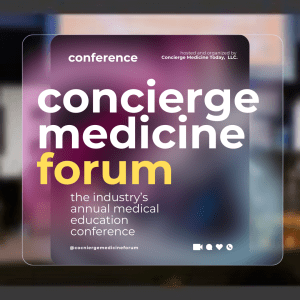
Industry’s Annual Conference
October 15-17, 2026 | Atlanta, GA USA
LEARN
New Here, Start Here →
Understand the Industry…
BUILD
Building or Refining a Practice →
Understand the Mindset & Culture…
Lead
Best Practices. Clear Thinking.
Credible Data. Real-World Insight →
Leadership Hub…

concierge medicine today’s
LEADERSHIP HUB
Concierge medicine today’s LEADERSHIP HUB, FOCUS AREA:
PATIENT EXPERIENCE
Designing Care Patients Stay FOR — and Talk About
This Focus Area exists to help physicians and care teams design patient experiences that are intentional, consistent, and worthy of long-term trust — not just short-term satisfaction.
In concierge and membership medicine, patient experience is not a department.
It is the strategy.
Clinical excellence may bring a patient through the door.
Experience determines whether they stay, refer others, and become long-term advocates for the practice.

What We Mean by Patient Experience
Patient experience is not luxury.
It is the sum of every interaction patients have with your practice:
First phone call
Website clarity
Onboarding process
Appointment flow
Follow-up communication
Billing conversations
After-hours interactions
How concerns are handled
Experience is what patients describe to friends when they say,
“You won’t believe how different this practice feels.”
Common Patient Experience Mistakes
Assuming friendliness equals excellence
Lack of structured onboarding
Inconsistent communication tone
Overpromising access
Ignoring small frustrations
Treating feedback defensively
Neglecting team training
Experience gaps rarely appear suddenly.
They accumulate quietly.
Why Patient Experience Is the Growth Engine
Membership-based medicine operates differently from volume-driven care.
Patients are not just receiving services.
They are choosing an ongoing relationship.
That means experience drives:
Retention
Referrals
Reputation
Community perception
Media narratives
Long-term sustainability
A single exceptional clinical encounter will be remembered.
A consistently exceptional experience will be talked about.
When Patient Experience Is Working Well
You will notice:
High retention
Organic referrals
Calm daily operations
Fewer misunderstandings
Positive word-of-mouth
Stronger community reputation
Patients may not use the term “experience.”
They simply say, “This practice is different.”
The Core Pillars of Exceptional Patient Experience
By Concierge Medicine Today
-
Patients do not remain in membership practices out of obligation.
They stay because the experience consistently reinforces value.Strong retention comes from:
Predictable access
Clear communication
Personal recognition
Respect for time
Proactive care coordination
Calm, organized environments
If patients cannot easily articulate why they stay, long-term retention weakens.
Experience must be tangible.
-
Onboarding is not administrative.
It is foundational.A strong new-patient experience should:
Clearly explain how membership works
Set communication expectations
Introduce the care team
Outline response times
Review billing and policies
Provide written reference materials
Create immediate confidence
Confusion early becomes dissatisfaction later.
Clarity at the beginning prevents friction.
-
Patients often join concierge practices for access.
But access must be structured thoughtfully.High-performing practices deliver:
Timely appointment availability
Clear urgent vs routine communication channels
Reliable follow-up
Transparent boundaries
Respectful scheduling
Access without structure creates stress.
Structured access creates confidence. -
Patients evaluate experience primarily through communication.
Key standards include:
Prompt acknowledgment of messages
Realistic response timelines
Consistent tone across team members
Plain-language explanations
Proactive updates
Thoughtful follow-up after visits
Patients should never wonder:
“Did they receive my message?”
“Who should I contact?”
“Am I bothering them?”Confidence grows when communication feels predictable.
-
Patients experience the entire practice — not just the physician.
That includes:
Front desk interactions
Clinical support staff
Billing communication
Phone etiquette
Email tone
Office environment
Every team member contributes to the patient’s perception of value.
Consistency matters more than perfection.
-
Memorable experiences do not require luxury spending.
They require intentional design.
Examples:
Remembering personal details appropriately
Following up after major life events or procedures
Simplifying complex processes
Providing clear next steps after visits
Reducing waiting and uncertainty
Anticipating common needs
Patients talk about experiences that feel thoughtful — not theatrical.
From Remark-ology:
Practices grow when patients can easily describe what makes them different. -
No practice avoids occasional dissatisfaction.
High-trust practices:
Address concerns quickly
Listen without defensiveness
Clarify misunderstandings
Document recurring issues
Adjust systems when needed
Maintain professional boundaries
How a concern is handled often determines whether a patient becomes more loyal — or quietly leaves.
-
Experience promises must match operational reality.
Marketing messages about:
Unhurried care
Direct access
Personalized service
Must be supported by:
Scheduling structure
Staffing levels
Communication systems
Technology reliability
If operations cannot support the promise, the experience will eventually feel inconsistent.
Alignment builds credibility.
-
Patient experience must remain compliant and professional.
Avoid:
Overpromising outcomes
Creating unrealistic availability expectations
Implying guaranteed savings or results
Blurring professional boundaries
Using incentives that could create regulatory concerns
Experience should elevate professionalism — not compromise it.
Resources in This Focus Area
Books
No More Waiting Rooms – Operational excellence and service design
Marketing Your Brand of Membership Medicine – Communicating value clearly
Guides & Tools
Podcast Episodes
The Leadership Standard
The future of concierge and membership medicine will be shaped by practices that deliver experiences patients cannot easily find elsewhere — not because of luxury, but because of intentional care.
Design care patients:
Stay FOR
Respect
Trust
Recommend
Patient experience is not a finishing touch.
It is the reason the model works.