
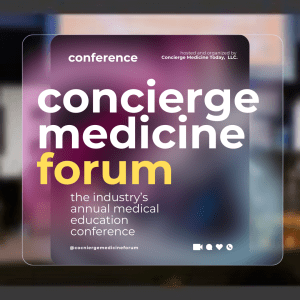
Industry’s Annual Conference
October 15-17, 2026 | Atlanta, GA USA
LEARN
New Here, Start Here →
Understand the Industry…
BUILD
Building or Refining a Practice →
Understand the Mindset & Culture…
Lead
Best Practices. Clear Thinking.
Credible Data. Real-World Insight →
Leadership Hub…

concierge medicine today’s
LEADERSHIP HUB
FROM OUR VANTAGE POINT, HOW WE SEE THINGS —
common FAQs & MYTHS
Here’s a quick rundown and a few fast facts and FAQs to get you up to speed on this subscription-driven disruptive shift in our healthcare marketplace.

THE FULFILLMENT FACTOR
“Fewer patients doesn’t mean less care; it means more intentional care, longer careers, and patients who finally feel seen. Over the years, when we’ve asked experienced concierge physicians what’s changed for them, they don’t talk about revenue or time off — they talk about joy. These doctors are rediscovering why they started, again. And as one concierge medicine physician reminded us just last month at our industry conference, ‘When the doctor’s fulfilled, the patient benefits too. You can’t fake that kind of energy in an exam room.’ These models are raising the bar for satisfaction on both sides of the room — doctors are staying in practice longer, and patients are reminded what it feels like to be genuinely cared for.”
— Editor-in-Chief, Concierge Medicine Today, February 2026 | Listen to Latest Podcast Episode →
FROM OUR VANTAGE POINT, HOW WE SEE THINGS —
common FAQs & MYTHS
Here’s a quick rundown and a few fast facts and FAQs to get you up to speed on this subscription-driven disruptive shift in our healthcare marketplace.
Why They Thrive
“The physicians who thrive in concierge medicine share four traits: curiosity about patients, humility as leaders, gratitude for those they serve, and a heart for their community. At the end of the day, healthcare isn’t just about medicine — it’s about people. One longtime concierge physician we spoke with notes that most doctors enter medicine to know their patients, not just to treat them. ‘When you actually have time to listen,’ he said, ‘you rediscover why you became a doctor in the first place.’ Patients may forget the paperwork or the plan, but they’ll never forget how you made them feel.”
— Editor-in-Chief, Concierge Medicine Today
People Before Process
“Concierge practices today are typically known for their focus on prevention and the close-knit relationships between physician, staff, and patient. One longtime physician told us, ‘I don’t need to pull up a chart to remember who someone is. I know their story, their family, their goals.’ That’s what makes this model so different. It’s personal, not transactional. Healthcare may be a process, but the patient should never feel processed.”
— Editor-in-Chief, Concierge Medicine Today
Are self-pay and cash-only practices categorized within the ‘concierge’ or ‘subscription’ marketplace?
“In summary, the answer is no. This is primarily due to the qualifying term ‘subscription,’” explains the Editor-in-Chief of Concierge Medicine Today. “In the past, sources indicated that there exists an unknown number of independent physicians (or practitioners) working across the U.S. who practice some variation of cash-only or self-pay healthcare, yet are not associated with any marketing label, organization, consulting agency, or brand as we understand them today. While this is likely accurate when examining other facets of the self-pay and cash-pay healthcare landscape, these practitioners technically do not align with the three main subscription-based healthcare delivery models that are predominantly operational in today’s market. Therefore, previous figures estimating these programs in the tens of thousands likely included those self-pay and cash-only practitioners — however, we now observe that the subscription-based healthcare delivery market is robust enough to stand independently and be recognized on its own.”
The Fulfillment Factor
“Fewer patients doesn’t mean less care; it means more intentional care, longer careers, and patients who finally feel seen. Over the years, when we’ve asked experienced concierge physicians what’s changed for them, they don’t talk about revenue or time off — they talk about joy. These doctors are rediscovering why they started, again. And as one concierge medicine physician reminded us just last month at our industry conference, ‘When the doctor’s fulfilled, the patient benefits too. You can’t fake that kind of energy in an exam room.’ These models are raising the bar for satisfaction on both sides of the room — doctors are staying in practice longer, and patients are reminded what it feels like to be genuinely cared for.”
— Editor-in-Chief, Concierge Medicine Today
Clear. Corrective. Uncomfortable.
“Much of the criticism around concierge medicine focuses on ‘access,’ but that framing misses the bigger issue. Access isn’t just about volume or panel size—it’s about whether physicians can sustainably remain in practice at all. Burnout, early retirement, and reduced clinical hours have quietly rationed care for years. Membership-based models didn’t create those pressures; they emerged as a compliant, rational, thoughtful and transparent response to them. When structured correctly, concierge medicine operates within existing regulatory frameworks and simply restores time, continuity, and professional durability. A system that looks equitable on paper but steadily drives experienced physicians out of medicine isn’t protecting access—it’s just very good at measuring it.”
— Editor-in-Chief, Concierge Medicine Today
What the Explosive Growth (Circa 2026) of Concierge Medicine Really Means¹²³⁴⁵⁷
“This data doesn’t tell the story critics want it to tell — it tells the story medicine has been avoiding. Physicians aren’t leaving traditional care because concierge medicine is ‘tempting.’ They’re leaving because the existing system is structurally unsustainable. When 83% growth happens in five years, that’s not a boutique trend — that’s a market signal. It’s physicians voting with their feet for smaller panels, better access, and clinically sustainable work.
The real concern isn’t that new models are growing. It’s that traditional primary care hasn’t been redesigned to keep doctors practicing longer, patients better served, and communities stable. If policymakers want access equity, the solution isn’t restricting innovation — it’s fixing reimbursement, reducing administrative drag, and making primary care viable again. Concierge and membership models didn’t create this pressure. They simply exposed it.”
— Editor-in-Chief, Concierge Medicine Today
Proving What’s Possible
“Concierge medicine often gets criticized as catering only to the affluent. But one longtime concierge physician we spoke with sees it differently. ‘Every innovation starts in a focused setting before it becomes accessible,’ the physician explained. ‘That’s not elitism — that’s how progress works. Someone has to prove it, refine it, and build the roadmap so others can follow.’ This physician went on to say that today’s concierge, aesthetics and plastic, and precision models aren’t about exclusivity — they’re about experimentation and validation. ‘We’re testing what’s possible,’ they said, ‘so the next generation of doctors and patients can experience what’s practical.’ So, It’s not about keeping healthcare narrow; it’s about paving the path to make it broader, smarter, and more sustainable.”
— Editor-in-Chief, Concierge Medicine Today
Are 'concierge' or 'subscription' models in healthcare classified as part of the self-pay and cash-only marketplace?
"In short, yes! However, this is primarily due to the key term 'self-pay,'" remarked the Editor-in-Chief of Concierge Medicine Today. "We're observing an increase in self-pay and cash-only practices within the U.S. healthcare system."
Why the reduced Patient Panels, does this really allow for more focus and attention on the patient?
"Healthcare is a process to be sure, but the patient should never feel processed. More often than not, concierge medicine practices have reduced patient panels of 225-550 to that compared to the traditional, plan reimbursed practices which usually boast 2,500-5,000."
~Editor-in-Chief, Concierge Medicine Today
Known, Not Processed
“Concierge practices today are typically known for their focus on prevention and the close-knit relationships between physician, staff, and patient. One longtime physician told us, ‘I don’t need to pull up a chart to remember who someone is. I know their story, their family, their goals.’ That’s what makes this model so different. It’s personal, not transactional. Healthcare may be a process, but the patient should never feel processed.”
— Editor-in-Chief, Concierge Medicine Today
The Specialty Mix
“In 2024, polling by Concierge Medicine Today, LLC. of 300 physician readers practicing within the concierge medicine model (2014–2024) identified the top six specialties represented in the field: Family Medicine (38%), Internal Medicine (32%), Osteopathic Medicine (9%), Cardiology (8%), Nephrology (3%), and Pediatrics (3%).”
— Editor-in-Chief, Concierge Medicine Today
What Patients Remember
“The physicians who thrive in concierge medicine share four traits: curiosity about patients, humility as leaders, gratitude for those they serve, and a heart for their community. At the end of the day, healthcare isn’t just about medicine—it’s about people. Patients may forget the procedure, the paperwork or what the doctor actually said earlier that day in the exam room, but they’ll never forget how you made them feel.”
— Editor-in-Chief, Concierge Medicine Today
What Critics Get Right—and What They Miss
“Concierge medicine is often criticized for limiting access, but that framing oversimplifies the issue. Access has never been defined solely by visit volume or panel size, nor is it how regulators evaluate care models. Medicare and federal regulators focus on compliance, transparency, clearly defined services, and fair market value—not on maximizing daily throughput. The law does not require physicians to practice unsustainably.
What’s frequently overlooked is that access has already been constrained through long waits, abbreviated visits, administrative burden, and physician burnout that leads to reduced hours or early exit from practice. Research consistently shows burnout is associated with lower clinical capacity and higher turnover, at a time when national workforce projections anticipate a significant physician shortfall. In that context, practice models that enable physicians to remain in clinical care longer warrant serious consideration.
When structured appropriately, concierge medicine operates within existing legal and regulatory frameworks and does not promise outcomes—only time, availability, and continuity. It does not create scarcity; it responds to it. Sustainable physicians are a prerequisite for sustainable access.
— Editor-in-Chief, Concierge Medicine Today
Verified Sources (Superscript References)
¹ Song Z, Zhu J, Marsh T, Polsky D, Huntington A. Growth and Characteristics of Concierge and Direct Primary Care Practices, 2018–2023. Health Affairs. Dec 2024.
https://www.healthaffairs.org/doi/10.1377/hlthaff.2024.XXXX
² Medicare Payment Advisory Commission (MedPAC). Physician Fee Schedule Update Reports. 2024–2025.
https://www.medpac.gov
³ American Medical Association. 2023 Prior Authorization Physician Survey.
https://www.ama-assn.org/practice-management/prior-authorization
the normalization of burnout
“The real threat to medicine isn’t concierge care—or any other membership or subscription-based practice model. It’s the normalization of physician burnout, and the quiet acceptance of systems that expect physicians to endure it as a cost of doing business. Reversing that trajectory requires less finger-pointing and more leadership. And leadership, by definition, begins with reflection—and action—within the healthcare profession at-large.”
— Editor-in-Chief, Concierge Medicine Today
Relational by Design
“Concierge medicine may still be small in size, but it’s big in purpose. While fewer than two percent of U.S. physicians practice in some form of membership-based model, what we’re seeing is steady, healthy expansion — about four to seven percent each year. Some insiders say it’s higher, but we prefer to stay realistic, not evangelistic. As one veteran concierge medicine physician told us just recently, ‘You can’t measure this movement only by numbers. You measure it by the physicians who’ve decided to practice medicine the way it was meant to be practiced — thoughtfully, relationally, and sustainably.’ So while concierge medicine represents a small slice of the healthcare pie, it’s quickly becoming the model others are measured against.”
— Editor-in-Chief, Concierge Medicine Today
Challenging Assumptions
“Concierge medicine isn’t exacerbating the physician shortage — it’s revealing it. And that’s a good thing. Every industry eventually faces a moment when disruption forces reflection and reinvention — this is healthcare’s moment. One longtime doctor told us, ‘The system didn’t break overnight. It’s been eroding for decades. Concierge medicine just held up a mirror.’ Critics may not like that, but that’s often what happens when new ideas challenge old assumptions. Change makes people uncomfortable — especially when it highlights what’s not working.”
— Editor-in-Chief, Concierge Medicine Today
Is there a strong focus on prevention, routine examinations and a deeper relationship with patients:
"Concierge Medicine practices and programs today are typically known for their focus on prevention and have often curated strong relationships between Patients and the Physician and Patient and the staff. So in essence, staff and Doctors don’t usually have to look at a medical chart to remember your name."
~Editor-in-Chief, Concierge Medicine Today
Are there many self-pay and cash-only healthcare practices in the U.S. today that do not include subscriptions or memberships in their services?
"It's also challenging to pinpoint a specific number," stated the Editor-in-Chief of Concierge Medicine Today. "However, we have observed an increase in the number of self-pay and cash-only healthcare practices across the country. Here's what we've learned over the years about this landscape, which differs from the subscription-based healthcare model: Approximately 13% of family physicians now utilize cash-pay models (American Academy of Family Physicians; 2021); a survey indicates that 43% of practices provide cash payment options (MGMA; 2020); nearly 30% of Americans believe cash payments help reduce costs (Journal of Health Economics; 2022); and specialties like dermatology are increasingly adopting cash-only models due to their simplicity (Health Affairs; 2019)."
FOR Every Patient
“Ten years ago, concierge medicine was mostly a primary care story. Today, cardiologists, endocrinologists, OB-GYNs, gastroenterologists, and even oncologists are adopting the model. It’s no longer just a business model—it’s becoming a mindset across medicine. Concierge medicine physicians have found a more sustainable pace in their practice model whereby they see more clearly that excellence, regardless of it's form, in healthcare, it isn’t just clinical skill; it’s dignity, attention, timeliness, and clear communication—those aren’t extras, they’re expectations every patient has today. That’s why concierge medicine from my seat on the bus is becoming the new reference point. That’s why concierge medicine is quickly becoming the standard others are measured against. The future belongs to leaders who remove every unnecessary obstacle for the patient and build systems that make servanthood and gratitude for the patient in healthcare repeatable.”
— Editor-in-Chief, Concierge Medicine Today
Verified Sources (Superscript References COn’t)
⁴ American Medical Association. National Physician Burnout Survey.
https://www.ama-assn.org/practice-management/physician-health/national-physician-burnout-survey
⁵ Association of American Medical Colleges (AAMC). Projected Primary Care Shortage Report.
https://www.aamc.org/data-reports/workforce/report/physician-shortage
⁶ Sinsky C, et al. Factors Driving Physician Early Retirement. Mayo Clinic Proceedings.
https://www.mayoclinicproceedings.org
⁷ Shanafelt T, et al. Burnout and Physician Workforce Retention. Annals of Internal Medicine.
https://www.acpjournals.org
⁸ Bureau of Labor Statistics. Advanced Practice Clinician Workforce Growth.
https://www.bls.gov