
Industry’s Annual Conference
October 15-17, 2026 | Atlanta, GA USA
LEARN
New Here, Start Here →
Understand the Industry…
BUILD
Building or Refining a Practice →
Understand the Mindset & Culture…
Lead
Best Practices. Clear Thinking.
Credible Data. Real-World Insight →
Leadership Hub…
A CMT LEADERSHIP HUB FOCUS AREA
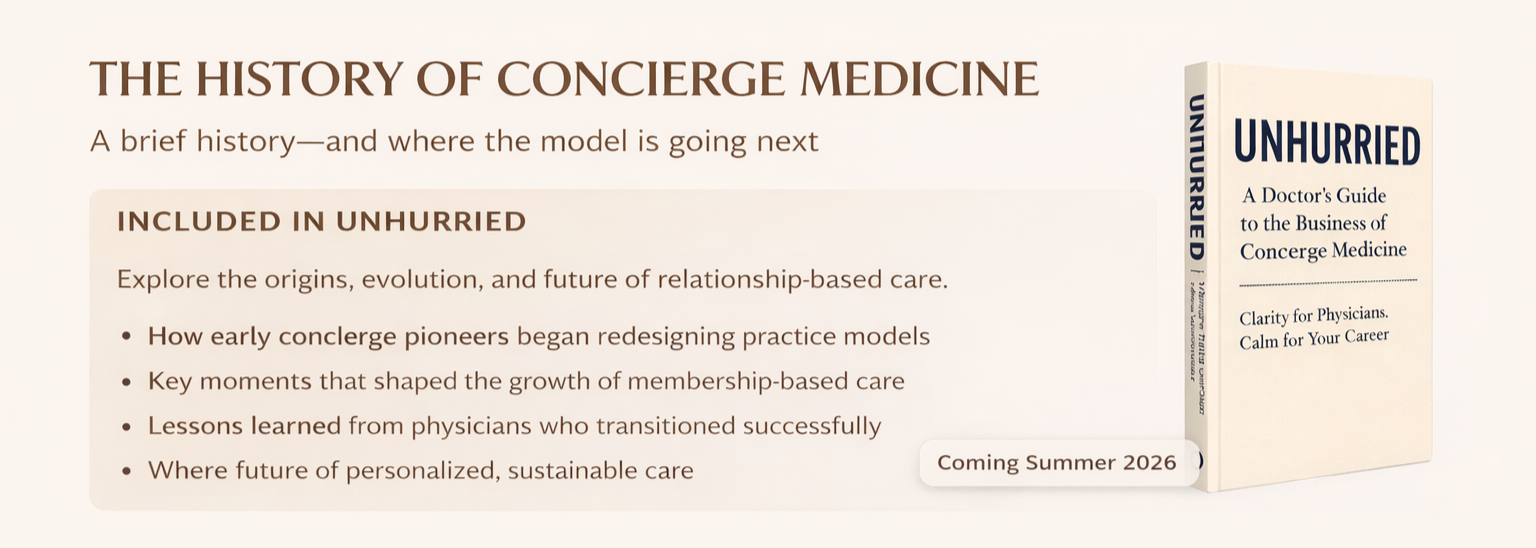
History of Concierge & Membership-Based Medicine
How relationship-centered care quietly reshaped modern practice
Additional leadership tools and practical resources are added periodically as new insights and conversations emerge across the field.
Editorially curated by Concierge Medicine Today
Documenting the evolution of membership & relationship-based care since 2007.

Concierge and membership-based medicine did not emerge overnight.
It evolved gradually as physicians across the country began rethinking how care could be delivered with more time, stronger relationships, and greater professional sustainability.
From its earliest pioneers to today’s modern relationship-based practices, this model has continued to develop in response to changing patient expectations, growing administrative complexity, and a renewed focus on continuity and trust in the physician–patient relationship.
Understanding the history of concierge medicine provides important context for where the model stands today — and where it may be heading. Much of that history has lived in real-world practice experience rather than textbooks or formal documentation.
This “Focus Area” section brings together a curated look at the origins, evolution, and current landscape of concierge and membership-based care, drawing from two decades of reporting, interviews, and industry conversations through Concierge Medicine Today, the Concierge Medicine Forum, and the DocPreneur Leadership Podcast.
The goal is not nostalgia.
It is clarity.
Because understanding how this model developed helps physicians and practice leaders think more clearly about its future.

The Early Origins: A Search for Time and Continuity
Concierge medicine first began to appear in the mid-1990s as a small number of physicians experimented with alternative practice structures designed to reduce patient panel size and restore time for more personalized care.
These early models often focused on enhanced access, longer visits, and greater continuity between physicians and patients. At the time, the concept was viewed by many as unconventional, even controversial. Yet for physicians exploring new ways to sustain meaningful patient relationships while navigating increasing administrative and reimbursement pressures, the model offered a different path.
What began as a handful of experimental practices gradually expanded as more physicians sought practice environments that allowed for deeper relationships and more manageable workflows.
Scroll down to read more…
“Concierge medicine may still be small in size, but it’s big in purpose. While fewer than two percent of U.S. physicians practice in some form of membership-based model, what we’re seeing is steady, healthy expansion — about four to seven percent each year. Some insiders say it’s higher, but we prefer to stay realistic, not evangelistic. As one veteran concierge medicine physician told us just recently, ‘You can’t measure this movement only by numbers. You measure it by the physicians who’ve decided to practice medicine the way it was meant to be practiced — thoughtfully, relationally, and sustainably.’ So while concierge medicine represents a small slice of the healthcare pie, it’s quickly becoming the model others are measured against.”
— Editor-in-Chief, Concierge Medicine Today, October 2025

1900’s
CASH-PAY HEALTHCARE
First Generation Iteration: Some experts trace the roots of this cash-pay healthcare model way back to 1913, with the focus on regular check-ups to keep sickness at bay and where a Doctor would carry a medical bag right into our home. This model however, has probably been cruising around for nearly a hundred years (or more), safeguarded by three federal statutes and a heap of Medicare/OIG guidance that many haven't even heard of.
The root of US cash healthcare was routine exam care, exams/communications detached from medical necessity and delivered on an ongoing basis regardless of condition. The concept can be found in a 1913 US medical practice that touted this as superior prevention/care (it was, still is). In 1920/1921, the same concept was envisioned as a US worker health solution, to increase productivity and better protect employees (Eischen; 2025).
1990’s
ENTER BESPOKE CARE
Second Generation Iteration (Bespoke Concierge Medicine): Bespoke or luxury concierge medicine birthed out of cash-only healthcare in the 1990’s. MD2 was key in starting concierge care by creating a new type of primary care that focuses on personal attention and easy access to doctors. Founded in 1996 by Dr. Geoffrey C. Friesen and Dr. John C. M. R. C. "Chuck" B. Friesen, MD2 offered a way for patients to get more time with their doctors and a variety of services for a yearly fee. This model changed how patients interact with healthcare, allowing them to receive better service and quicker care. It significantly influenced the growth of concierge medicine in today's healthcare system (Avery, A. & Barlow, J.; 2017).
In summary, and according to industry experts and sources over the years, in 1999, the term "concierge" emerged to define a cash healthcare model akin to the executive health model, with added claims of improved time and care coordination, etc — but it was still the same old model under the hood and more or less earned a thumbs-up from HHS in 2002 via public letters (Eischen; 2025).
ACROSS THE POND
For more context and additional information and education about concierge medicine and private practice services in the U.K., please see below.
The U.K.’s concierge medicine market has evolved from niche private GP care to a diversified sector with digital hybrids, corporate packages, and luxury health programs.
🕰 Historical Timeline — Concierge Medicine in the U.K.
(For reference and General Information Only - please see disclaimers)
Pre-2000s – Private GP Practices Exist but “Concierge” Term Rare
Private general practice existed for decades, mainly serving executives, diplomats, and private health insurance clients.
Most used pay-per-visit or corporate retainers rather than formal “concierge” branding.
Source: British Medical Association — Private practice in the UK: historical context — https://www.bma.org.uk
Early 2000s – Membership-Style GP Services Emerge
London clinics began offering annual retainers for unlimited GP visits, faster access, and longer consultations.
Example: The London General Practice began corporate and individual memberships.
Source: The London General Practice (Company History) — https://www.thelondongeneralpractice.com/about-the-london-general-practice/
Mid-2000s – U.S. Model Gains Attention
Media coverage introduced “American-style concierge doctors” to U.K. audiences.
2013 – Concierge Medical Practice Ltd Founded
Concierge Medical Practice Ltd incorporated on 20 February 2013.
Companies House confirmation: https://find-and-update.company-information.service.gov.uk/company/08387668
2014 – HealthClic Founded
HealthClic Ltd incorporated on 18 December 2014.
Companies House confirmation: https://find-and-update.company-information.service.gov.uk/company/09892983
2010–2015 – Corporate & International Patient Services Grow
Bupa, HCA Healthcare UK, and others bundle GP access with corporate health plans and executive screening.
Sources:
Bupa UK — https://www.bupa.co.uk/
HCA UK — https://www.hcahealthcare.co.uk
2016–2019 – Digital Concierge & Home Visit Services
Growth of subscription GP services combining home visits and telemedicine.
Examples:
Doctor Care Anywhere — https://www.doctorcareanywhere.com
GPDQ — https://www.gpdq.co.uk
2018 - 2020 - Media Coverage
Press Release - 2018 - (Credit: Concierge Choice Physicians) Concierge Choice Physicians Launches First-of-its-Kind Concierge Medicine Program in the UK -- London area doctors can now offer exclusive, limited-membership model to patients - https://www.prnewswire.com/news-releases/concierge-choice-physicians-launches-first-of-its-kind-concierge-medicine-program-in-the-uk-300727190.html
Article - (2019) - HealthClic Doctors and their team delve into another challenge faced when running a concierge medical service - https://conciergemedicinetoday.org/2019/12/24/healthclic-doctors-and-their-team-delve-into-another-challenge-faced-when-running-a-concierge-medical-service-2/
2020–2022 – COVID-19 Surge in Private GP Memberships
Financial Times - (2020) - Private groups race to meet Covid testing demand from UK companies - https://www.ft.com/content/17c5a06e-7987-415f-ad60-78102535a12f
Financial Times - (2022) - NHS backlog drives steep rise in self-pay healthcare - https://www.ft.com/content/81058c84-9b79-4e4d-927a-a85417b665de
2023–2024 – Luxury & Longevity Positioning
High-end providers integrate concierge GP into wellness and longevity programs.
Examples:
Mayo Clinic Healthcare London — https://www.mayoclinichealthcare.co.uk
Lanserhof at The Arts Club — https://www.lanserhof.com/en/
Financial Times - (2024) - Demand for private healthcare hits record high in UK - https://www.ft.com/content/a4f07a08-b7e9-4330-9915-c2640edf7866
Disclaimer: Some of the information in this publication was gathered with the assistance of generative AI tools. While we strive for accuracy and timeliness, this content may contain errors, omissions, or outdated details. It is provided for informational purposes only and should not be relied upon as medical, legal, or financial advice. Concierge Medicine Today, LLC. makes no representations or warranties regarding its accuracy or completeness and assumes no liability for any loss, injury, or damages arising from its use. We’ve cross-checked each link for accuracy and ensured they are publicly accessible as of today.
2000’s-today
THE ORIGINS OF (modern day) ‘CONTEMPORarY CONCIERGE CARE’ or, ‘personal care models’ (PCMs) FOUND TODAY
Third Generation Iteration:
(i.e. Personal Care Models or as some label, a contemporary or modern-day version of more affordable Concierge Care):
This third generation version (as we define it here) often gets tangled in myths misreported by the media and misunderstood by critics; not every provider charges like a five-star hotel (i.e. concierge medicine), and not every doc works for the cost of a hot dog and a handshake!
Roundabout the same time (i.e. late 1990s), the subscription-based economy was at its infancy outside of healthcare — Netflix, Amazon Prime and others were slowly moving into business scene..
While cash-only healthcare got a snazzy new brandname (i.e. concierge medicine or bespoke-luxury concierge care) the ‘opportunity cost’ from our economics classes started to make sense. There was ways to make bespoke concierge care more affordable and unite the hearts and hands of Doctors and patients alike to a new version of subscription-based healthcare delivery.
This version has struggled with labels often getting side eyes from some as being the bespoke version or not ‘affordable enough’ by altruistic PCPs. Nonetheless, it’s become the industry darlin in our POV.
Over the years, more Physicians and healthcare startups considered what patients give up when they make a choice. Early adopters of concierge medicine in the 1990s saw this idea as critically important for the future of healthcare. So, they created more new (yet affordable) business models in this sweet spot they saw in the healthcare space where patients paid a fee a subscription (or membership, whichever you prefer) for routine exams and more personal attentiveness from their Doctors office. This approach eventually allowed more and more doctors to focus on fewer patients, improve service quality, and provide a better overall experience than traditional healthcare (Hewitt, 2006; Chokshi, 2016).
MDVIP was soon born as well in 2000 from an idea that started in the minds of forward-thinking primary care doctors in the 1990’s who felt the healthcare system was losing its way. They knew there was a better way to practice medicine and provide the level of care and attention their patients deserved (MDVIP; April 2025).
In 2002 HHS/OIG tested MDVIP openly in public letter exchanges between Congressman Henry Waxman and HHS Secretary Tommy Thompson, and Mr. Thompson openly confirmed in a public letter (Eischen; 2025) that charging cash for services not covered by Medicare was lawful (validating the MDVIP model openly as Medicare compliant). MDVIP practices remain in Medicare, and bill plans, and charge cash for an annual routine exam, a follow-up consult, and marketing claims of extra time with/access to the physician (Eischen; 2025).
TERMINOLOGY
For more context and additional information and education about terminology used in this space and attributions, please see below. Please note, this section is meant to educate and inform and reinforce concierge medicine as a high-trust, patient-centered model with a sustainable business backbone. DPC, while philosophically similar, operates on a different economic premise (often low monthly fees and high volume) and is prone to misinterpretation, especially by media or physicians new to both models.
Disclaimers: However, please be aware that some of the information in this publication was gathered with the assistance of generative AI tools. While we strive for accuracy and timeliness, this content may contain errors, omissions, or outdated details. It is provided for informational purposes only and should not be relied upon as medical, legal, or financial advice. Concierge Medicine Today, LLC. makes no representations or warranties regarding its accuracy or completeness and assumes no liability for any loss, injury, or damages arising from its use. We’ve cross-checked each link for accuracy and ensured they are publicly accessible as of today.*
Timeline — Origins of Key Healthcare Terms IN THIS INDUSTRY OVER THE YEARS
1990s — “Concierge Medicine”
Widely credited to Dr. Howard Maron and Scott Hall of Seattle, WA, who founded MD² (MD Squared) in 1996, offering an upscale, retainer-based model for fewer patients and personalized care.
Early media coverage (1999 Seattle Times, 2000 New York Times) popularized the phrase “concierge medicine” in the U.S.
Sources:Maron, H. MD² official site: https://www.md2.com
McClure, R. “Seattle doctor starts upscale practice,” Seattle Times, Oct. 11, 1999.
Late 1990s — “Membership Medicine”
Used in marketing by early boutique medical practices to frame the retainer fee as a “membership.”
Term appears in Physician Executive journal (1999) to describe annual-fee primary care models.
Sources:Sager, A. & Socolar, D. Physician Executive, “The Boutique Medicine Phenomenon,” 1999.
2001–2003 — “Personalized Medicine”
Academic and policy use of “personalized medicine” grew after completion of the Human Genome Project (2003).
Term is often attributed to Dr. Leroy Hood (systems biology pioneer) who advocated genomics-based personalization in healthcare.
Sources:Hood, L. & Friend, S.H. “Predictive, Personalized, Preventive, Participatory (P4) Medicine,” Nature, 2004.
National Human Genome Research Institute: https://www.genome.gov
Mid-2000s — “Subscription-Based Healthcare Delivery”
Business and policy analysts began using this phrase to describe recurring-fee healthcare models, paralleling the “subscription economy” trend in other industries.
Earliest healthcare use appears in Health Affairs blog posts and consultancy white papers (2005–2008).
Sources:Deloitte Center for Health Solutions, “The Emergence of Subscription-Based Healthcare,” 2008.
2007–2010 — “Direct Primary Care”
Popularized by the Direct Primary Care Coalition and early DPC practices such as Qliance (founded 2007, Dr. Garrison Bliss, Seattle) and AtlasMD (Dr. Josh Umbehr, Wichita).
The term “direct primary care” appeared in Washington State legislation in 2007 and in national policy discussions by 2010.
Sources:Bliss, G. Qliance Media Kit, 2009.
WA State SB 5958 (2007), “Direct Patient-Provider Primary Care Practice.”
Direct Primary Care Coalition: https://www.dpcare.org
2010s — “Longevity Medicine”
Emerged in anti-aging and preventive medicine circles as precision health, biomarkers, and geroscience research matured.
Term used in Nature Aging and The Lancet Healthy Longevity in the early 2020s to describe physician-led interventions aiming to extend healthspan.
Sources:Zhavoronkov, A. “Longevity Medicine: from Bench to Bedside,” Nature Aging, 2021.
The Longevity Medicine Foundation: https://longevitymedicine.io
of note
DPC, CONSIDERED TO BE A DISTANT RELATIVE YET NOT TO BE CONFUSED WITH ‘BESPOKE’ nOR MORE ‘CONTEMPORARY’ VERSIONS OF CONCIERGE CARE NOR CONSIDERED CONCIERGE-STYLE ‘Personal CARE MODELS’ IN THE MARKETPLACE TODAY
Like a Fourth Generation Iteration (A distant cousin if you will): Not to be confused with bespoke-luxury concierge medicine practice models, nor present-day versions of membership-driven contemporary personal care models (PCMs) nor a contemporary iteration of concierge subscription healthcare practices, DPC is a modern-day, cash-only, no insurance, no Medicare, self-pay, reboot (or budget-friendly) subscription spin on the original 90’s luxury or bespoke concierge medicine subscription model that catered primarily to the affluent clientele years ago.
“In contrast, DPC arose as a response to insurance limitations for lower-income populations, focusing on lobbying for legal changes instead of adapting to existing regulations, often leading to violations. Steer clear of marketing and branding, that, while quite prevalent in the marketplace, is frustrating your patient fees achieving qualified medical expense status. For example, you may dearly love the DPC or concierge [as terms or] brands, but, the IRS is convinced that neither brand’s patient fees are qualified medical expenses. Why debate the IRS? Neither brand is likely to fully explain YOUR medical or healthcare philosophy, and neither brand assists with qualified medical expense status so both brands frustrate HSA/FSA/HRA/MSA funding absent changes in tax laws and IRS regulations.” (Eischen; 2025)
Update by Concierge Medicine Today (Jan 1, 2026) — “In light of the new 2025 ‘One Big Beautiful Bill’ Act (effective January 2026), federal law now explicitly allows health savings account (HSA) funds to be used for qualifying direct-primary-care (DPC)/concierge membership fees (Source: dlapiper.com) – but only under specific conditions. Under this law, a fixed-fee DPC arrangement covering only core primary-care services can qualify as a medical expense, provided the monthly membership fee stays under the IRS cap (roughly $150 per individual or $300 per family) (Source: irs.gov). Even so, the core warning remains: simply labeling a practice “concierge” or “DPC” still does not by itself guarantee HSA/FSA/HRA eligibility. Physicians should therefore seek guidance and advice from qualified and competent advisors, communicate carefully and transparently – clearly identifying which membership plans qualify under the new rules and which do not – so patients understand the limits on tax-advantaged payments (Source: dlapiper.comirs.gov).”
Typically (but not always which is why industry jargon can be confusing) DPC docs often urge their curious colleagues to ditch Medicare and kick insurance headaches to the curb and offer a more affordable fee. They champion a cash-only subscription model for primary care or family health services and those fees can range (typically, but not always) $50 to $150 per month per patient. This may (but not always) cover services like check-ups and preventive care (Baus, C. (2022). Baird, A. (2021); Peterson, J. (2021); Tew, J. (2020))
As of recent estimates (2025), there are about 1,200 to 1,500 Direct Primary Care (DPC) practices in the U.S., accounting for some closures. DPC is expected to grow at a rate of 10-20% annually, driven by increasing demand for personalized healthcare, excluding concierge medicine programs. ("The Future of Direct Primary Care" by the American Academy of Family Physicians; "Direct Primary Care" by the American College of Physicians; Articles in *Health Affairs* regarding DPC trends.)
Related to HSAs in 2026: "The expansion of HSAs—and the permanent inclusion of Direct Primary Care as an eligible expense—represents meaningful progress FOR patients seeking more flexibility in how they access and pay for care,” says Concierge Medicine Today’s Editor-in-Chief. “It is a positive step, particularly for those who value continuity, access, and a stronger relationship with their physician. At the same time, this moment invites thoughtful reflection within the broader primary care community. For decades, physicians have been trained to view primary care as the center of a patient’s healthcare journey—and for good reason. Strong primary care improves outcomes, enhances coordination, and builds trust over time. That shared foundation is something nearly all models of care agree on. Where Direct Primary Care can continue to mature is not in conviction, but in communication. Patients arrive with different needs, financial realities, and comfort levels. Some will benefit from a membership-based relationship; others may engage primary care through different structures. When DPC is presented as one effective option—rather than the only answer—it becomes easier for patients, employers, and policymakers to understand its role without feeling pressure to adopt a particular model. HSAs may help certain patients participate in DPC, but they are not a universal solution—and they need not be. The larger opportunity remains education: helping patients understand that primary care is fundamentally about relationship, time, and trust, regardless of how it is funded. The mechanism matters less than the experience it enables. The path forward is not louder messaging, but clearer explanation. When physicians lead with calm confidence and respect for patient choice, the value of relationship-based care tends to speak for itself—no megaphone required. (And thankfully, no 40-slide presentation either.)”
Key Inflection Points in the Field
Continuing the Conversation
At Concierge Medicine Today, we continue to document the evolution of membership-based care through interviews, conference discussions, physician polling, and ongoing editorial coverage. The history of concierge medicine is still being written — not only by early pioneers, but by the many physicians and care teams continuing to refine and adapt these models today.
Understanding this history is not about looking backward.
It is about providing context for thoughtful decisions moving forward.
Several broader healthcare trends have influenced the growth of concierge and membership-based care:
Rising administrative burden and documentation demands
Increasing physician burnout and workforce concerns
Growing patient interest in personalized, accessible care
Advances in digital communication and telehealth
Greater emphasis on prevention and continuity
While no single factor drove the model’s expansion, together these trends contributed to growing interest in alternative practice structures that prioritize time, access, and relationships.
Where the Model Stands Today
Today, concierge and membership-based medicine continues to evolve. Practices range from small independent offices to larger multi-physician groups and specialty-focused models. Some physicians transition fully into membership-based care, while others incorporate hybrid structures within broader systems.
Despite this growth, misconceptions remain common. Public discussion often focuses narrowly on pricing or access, while overlooking broader conversations around sustainability, continuity, and long-term physician workforce stability.
As healthcare continues to change, relationship-based care models are likely to remain part of the broader conversation about how physicians and patients engage in meaningful, sustainable care over time.
Distinctions within the model
How Concierge Medicine and Direct Primary Care Differ
Direct primary care (DPC) is like concierge medicine in the sense that practices charge a flat fee to patients and offer members greater access to in-person and virtual care. However, there are two key differences. (Eastwood; 2022)
One is that, as the name implies, DPC is solely for primary care, while concierge medicine may also cover specialty care. This tends to make DPC less expensive than concierge medicine but also less comprehensive in the services it can offer. (Eastwood; 2022)
The other is that DPC practices don’t accept insurance, while the American Academy of Private Physicians estimates that 75 percent of concierge medicine practices do. (Generally, concierge practices that don’t accept insurance tend to charge higher membership fees, according to AARP.)
For patients, insurance covers care that’s not included in the membership fee. For practices, insurance reimbursement provides an additional revenue stream; Jorgensen says MDVIP gets about 20 percent of revenue from insurance, which is roughly an even mix of Medicare and commercial plans. (Eastwood; 2022)
In summary, while DPC shares some distant genetic traits to other subscription healthcare delivery ancestors, DPC is essentially just a distant relative (as an example) of subscription healthcare delivery option trying to build its own sand castle on the beach with the some of other subscription options in the healthcare marketplace.
The term "Direct Primary Care" (DPC) does not have a single universally agreed-upon “inventor,” but the historical trail points to:
Earliest Roots
In the early 2000s, several small physician groups in the U.S. began using the term “direct care” or “direct primary care” to distinguish their monthly-fee, non-insurance model from “concierge medicine.”
Qliance in Seattle, founded in 2007 by Dr. Garrison Bliss and Dr. Erika Bliss, is widely credited with popularizing the term “Direct Primary Care” in the press and policy discussions. They were among the first to lobby for explicit legal recognition of the term.
Before Qliance, some pioneering practices (e.g., Bliss MD in 1997, and a few early 2000s family practices) used “direct care” or “direct practice” in marketing, but the “primary care” modifier became more consistent by the mid-2000s.
Key Milestones
2007: Qliance launches and explicitly brands itself as a “Direct Primary Care” company.
2008: The Washington State Legislature passes a law defining and legalizing “Direct Patient Care” arrangements, influenced by Qliance’s lobbying.
2010: National media (e.g., The New York Times, Wall Street Journal) begins using “Direct Primary Care” in articles describing low-cost, membership-based alternatives to traditional insurance.
2014 onward: The DPC Alliance, DPC Frontier, and other advocacy groups cement “Direct Primary Care” as the industry-standard term.
OTHER Distinctions Within the Model
As the field developed, several variations of membership-based care began to take shape. While often grouped together in public conversation, these models differ in structure and emphasis.
Concierge Medicine
Typically combines membership or retainer fees with insurance billing and emphasizes enhanced access, continuity, and personalized service.
Direct Primary Care (DPC)
Often structured around a monthly membership covering most primary care services without traditional insurance billing for those services.
Hybrid & Specialty Membership Models
Include a range of variations across primary care and specialty practices, each adapting relationship-based principles to different clinical settings.
Understanding these distinctions helps clarify ongoing discussions about access, sustainability, and the evolving role of relationship-centered care.